Tractors
Trucks
- Find by Budget
- Find by Type
Buses
- Find by Budget
- Find by Type

English
 New Delhi
Propel is a leading manufacturer and supplier of equipment for crushing, screening, and washing in the mining, quarrying, and recycling sectors.

By Priya Singh
Key Highlights:
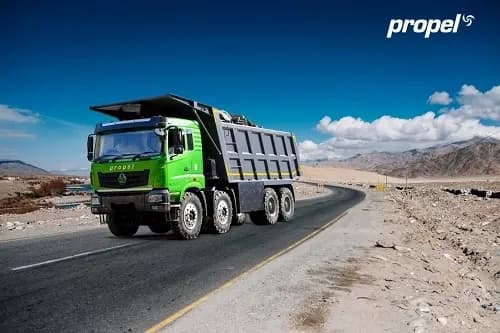
Propel Industries, recognized as India's fastest-growing manufacturer of crushing equipment, has achieved an important milestone. The company's electric heavy-duty Tipper, the 470 HEV, has received Homologation certification. This certification confirms that the vehicle meets the necessary safety standards and is roadworthy as per government regulations.
Features of the 470 HEV Tipper
The 470 HEV Tipper is India's first smart electric heavy-duty tipper, available in two battery options: 385 kWh and 256 kWh. It features:
Built to tackle demanding tasks in mining and construction, it boasts a liquid-cooled motor, clutch-less AMT transmission, ABS, and a noise-free cabin for improved operator comfort. Its compact design allows for excellent maneuverability, making it suitable for both on-road and off-road use.
Statement from the Managing Director
V. Senthil Kumar, Managing Director of Propel Industries, expressed his enthusiasm for this achievement. He stated that the 470 HEV Tipper was originally designed for off-road applications. He described the Homologation certification as a groundbreaking accomplishment, emphasizing Propel's commitment to innovation and sustainability in the industry. Kumar noted that this certification is a significant step forward for electric mobility in India's mining and construction sectors.
Environmental Responsibility
The 470 HEV Tipper emphasizes environmental responsibility with zero emissions, lower noise levels, and asbestos-free brake liners. This achievement reflects Propel Industries' dedication to transforming electric mobility by providing sustainable and high-performance equipment for the mining and construction sectors.
About Propel Industries
Propel is a leading manufacturer and supplier of equipment for crushing, screening, and washing in the mining, quarrying, and recycling sectors. Propel Industries was established in 2009 and is based in Coimbatore, India. It is part of the AV Group, which has been in operation for over 60 years and generates around ₹3,000 crore in revenue.
Their product lineup features a variety of machines, including jaw crushers, cone crushers, horizontal and vertical shaft impactors, vibrating screens, washing systems, and mobile crushers and screens. Recently, Propel introduced a new 60-ton electric dumper truck to the Indian market.
The company focuses on modern manufacturing practices, strong research and development, and sustainable operations, with a manufacturing space exceeding 750,000 square feet. Propel has established a significant presence in India and operates in over 26 countries worldwide, including regions in Africa, the Middle East, Southeast Asia, and Latin America, with more than 3,000 plant installations.
Also Read: Ashok Leyland Inaugurates New LCV Dealership in Udaipur
CMV360 Says
The certification of Propel Industries' 470 HEV Tipper is an important development for electric vehicles in India's mining and construction sectors. It demonstrates Propel's commitment to innovation and efficiency in their products. This achievement encourages other companies to focus on advanced solutions in their offerings.


 Add CMV360 on Google